BoxKaki Blog
Foil stamping vs spot UV for Malaysian brand packaging
A sourced Malaysian buying guide to foil stamping and spot UV, covering appearance, artwork, samples, quote comparison and current supplier cost signals.
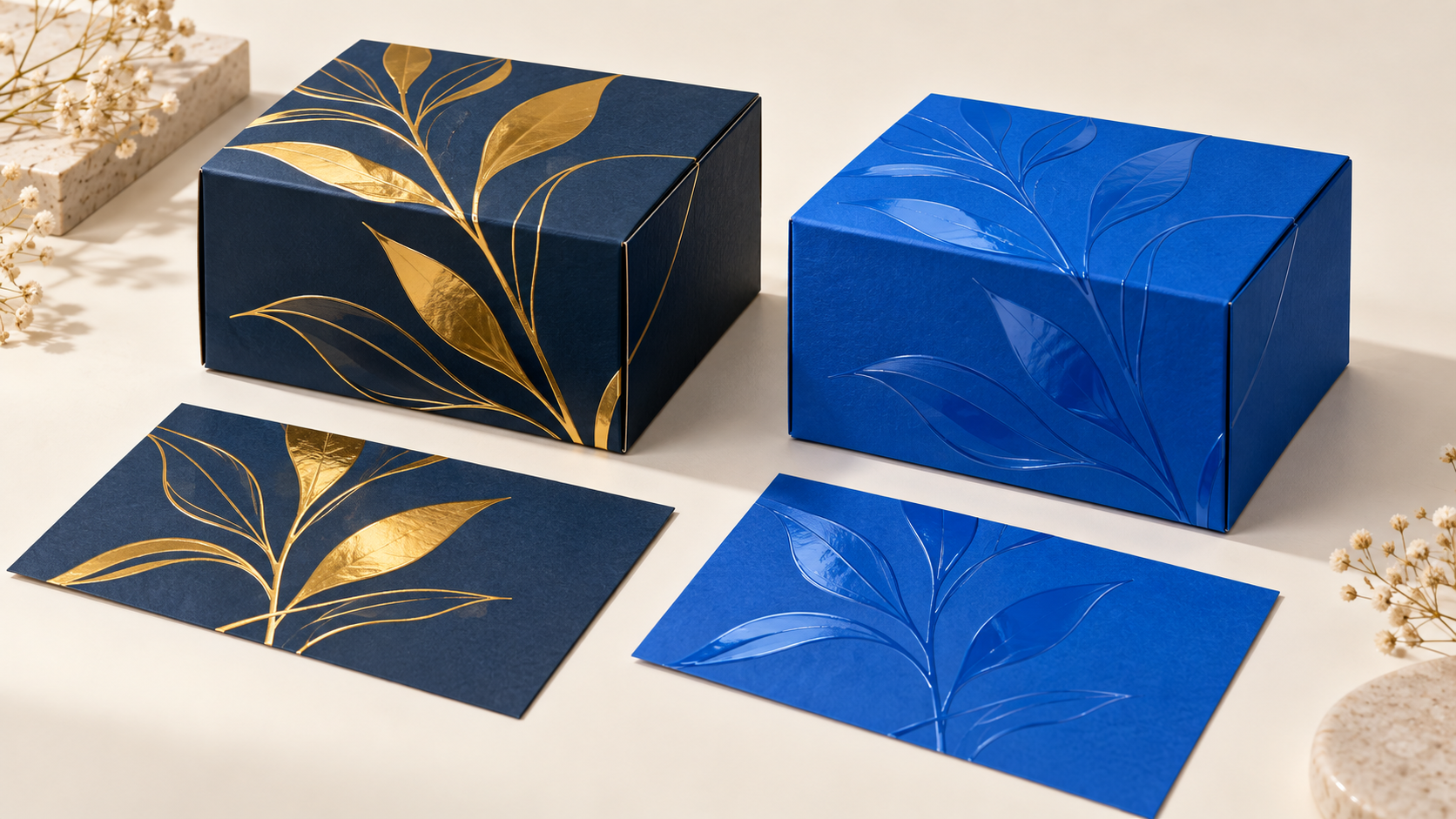
A metallic logo and a glossy logo may look similar on a screen, but they are different production jobs. Foil adds a new surface material. Spot UV leaves the printed colour visible and changes how selected areas reflect light. Malaysian brand owners need to specify the intended effect before asking suppliers to price it.
This is a research-led buying guide for cosmetics, food and beverage gifts, and retail packaging. BoxKaki has not handled samples from the suppliers cited here. Process descriptions come from the named publishers, and current Malaysian figures are kept as supplier claims. Our research methodology explains how we separate evidence from editorial guidance.
The short answer
- Choose hot foil when the design needs a metallic or pigmented surface that sits apart from the printed colour.
- Choose spot UV when the printed artwork should remain visible under a selective gloss effect.
- Ask the converter to confirm the exact substrate, laminate, artwork mask, coverage, process order and tolerances for your job.
- Do not assume one finish has a lower setup cost. The current Malaysian source reviewed here groups spot UV and hot foil in the same per-unit range and does not publish a finish-specific setup comparison.
- Approve a physical sample on the intended board and laminate before production.
What each process does
Made Good Designs describes spot UV as a clear, selectively applied varnish cured with ultraviolet light. The printed colour remains visible beneath it. The same guide describes hot foil stamping as a process that uses heat, pressure and a metal die to transfer metallic or coloured foil to the surface (Made Good Designs: Spot UV vs Foil Stamping).
Malaysian printer BOXCO gives the same practical distinction in its current FAQ: spot UV adds gloss to selected areas, while hot stamping applies metallic foil. BOXCO also lists box size, material, order quantity and extra finishes as separate pricing factors (BOXCO Custom Box Printing Malaysia FAQ).
| Decision point | Hot foil stamping | Spot UV |
|---|---|---|
| What is added | Metallic or pigmented foil | Clear selective varnish |
| What happens to the print below | The foil creates its own surface colour in the stamped area | The printed colour remains visible |
| Main visual effect | Metallic reflection or opaque colour | Gloss contrast against the surrounding surface |
| Tooling | Hot foil uses a metal die | No metal foil die; the supplier still needs an application mask or screen for its workflow |
| Approval question | Does this exact foil transfer cleanly to this board? | Does this varnish adhere and show enough contrast on this laminate or coating? |
Choose by the effect, not the finish name
Foil is the clearer candidate when the artwork needs a metallic wordmark, border or emblem. Spot UV is the clearer candidate when a printed pattern or logo should stay the same colour and become visible through gloss as the pack moves under light.
Neither finish is automatically raised. A printer may offer embossing with foil, or a thicker tactile varnish, but those are additional specifications. Ask whether the quoted finish is flat or raised and approve the answer on a physical sample.
The surrounding finish matters. Spot UV usually shows more contrast against a matte surface than a glossy one. Foil transfer depends on the complete surface construction, including board, ink and laminate. Treat these as sample questions rather than universal compatibility rules.
Artwork and production questions
Do not reuse one generic artwork note for every converter. Request the selected supplier's current template and ask it to mark:
- the separate foil or varnish mask;
- the smallest positive line, reversed gap and text size it accepts;
- clearance from cuts, folds and glue areas;
- registration allowance against printed artwork;
- maximum practical coverage;
- the required file format, named spot layer and proofing method.
These limits depend on the supplier's equipment and the proposed material. This guide does not substitute one printer's line or registration tolerance for another printer's production specification.
If the design uses both finishes
Foil and spot UV can appear on the same pack, but there is no single process order that applies to every press, coating and laminate. Send the complete construction to the converter and ask it to state the order, separation between finish areas and any areas that must be knocked out. Approve the converted sample, not only the screen artwork.
This is especially important where foil and varnish meet the same printed element. A supplier may need overlap, separation or a different sequence to suit its equipment. The production order belongs in the written quotation or proof approval.
Current Malaysian supplier cost signals
AEC Packaging published the following Kuala Lumpur figures on 1 September 2026. BoxKaki checked the page on 2 October 2026. They are one supplier's indicative figures, not Malaysian market averages and not BoxKaki prices (AEC Packaging: Custom Box Packaging in Kuala Lumpur).
| Line item | AEC published figure | How to use it |
|---|---|---|
| Spot UV or hot foil | RM0.20 to RM1.00 per unit | A combined finish range; it does not prove which finish is cheaper for a matched job |
| Matte or gloss lamination | RM0.10 to RM0.40 per unit | Request it as a separate line if the finish needs a laminated base |
| Custom box packaging overall | RM0.30 to RM8.00 per unit | A broad supplier range across box types, sizes, materials, print methods and finishes |
| Die-cut tooling for custom shapes | RM300 to RM1,500 one time | Structural die-cut tooling, not a published hot-foil die price |
| Delivery | Most KL suppliers deliver within Klang Valley free above RM500 | AEC's published market claim; confirm the selected supplier's destination and threshold |
AEC publishes quantity tiers for digital and offset box printing, but those are not finish-specific MOQs. Ask each converter for the MOQ that applies to the exact box, print method, foil or varnish coverage and finishing sequence.
How to compare two quotations
Use the same artwork, box structure, board, print, laminate, finish coverage and quantity for both requests. Then compare these lines:
- Hot foil, spot UV or another named process.
- Finish setup or tooling, itemised.
- Per-unit finishing charge.
- Board, printing and laminate.
- Physical sample or press proof.
- Production and courier lead times.
- Tax and delivery.
A useful calculation is: landed unit cost = total quoted production, tooling, finishing, delivery and applicable tax divided by the accepted quantity. Use only figures from the supplier's written quotation. A missing line is unavailable, not zero. Our quotation comparison guide and pre-quote checklist help keep the requests matched.
Strengths and limits
Hot foil stamping
- Useful when the design requires metallic reflection or an opaque decorative colour.
- Requires the foil, board and die process to work together on the proposed surface.
- The reviewed sources do not provide a Malaysian foil-die price that can be applied to every job.
Spot UV
- Useful for selective gloss while preserving the printed colour below.
- The effect depends on the surrounding surface and the varnish process.
- The reviewed sources do not establish that its setup is always cheaper than hot foil.
Frequently asked questions
Can I use both finishes on the same box?
Yes, if the selected converter confirms the material compatibility, masks, separation and process order. Ask for that sequence in writing and approve a physical sample.
Which finish is cheaper to set up?
The reviewed Malaysian figures do not answer that question. AEC groups spot UV and hot foil in one per-unit range and does not publish a matched setup comparison. Request separate setup and per-unit lines from each supplier.
Will foil or spot UV work on any paper?
Do not assume it will. Ask the converter to test the exact board, ink and laminate combination, then approve the intended effect on a physical sample.
Verdict and next step
Choose foil when the design needs a new metallic or opaque surface. Choose spot UV when the printed design should remain visible and gain selective gloss. Before deciding on cost, send matched specifications to at least two suppliers and compare their written setup, unit, sample, delivery and tax terms.
BoxKaki has not hands-on tested either finish. Check the current supplier pages and the BoxKaki methodology before relying on a dated figure.
Sources
- Made Good Designs: Spot UV vs Foil Stamping (published 20 March 2026; accessed 2 October 2026)
- BOXCO Custom Box Printing Malaysia FAQ (accessed 2 October 2026)
- AEC Packaging: Custom Box Packaging in Kuala Lumpur (published 1 September 2026; accessed 2 October 2026)